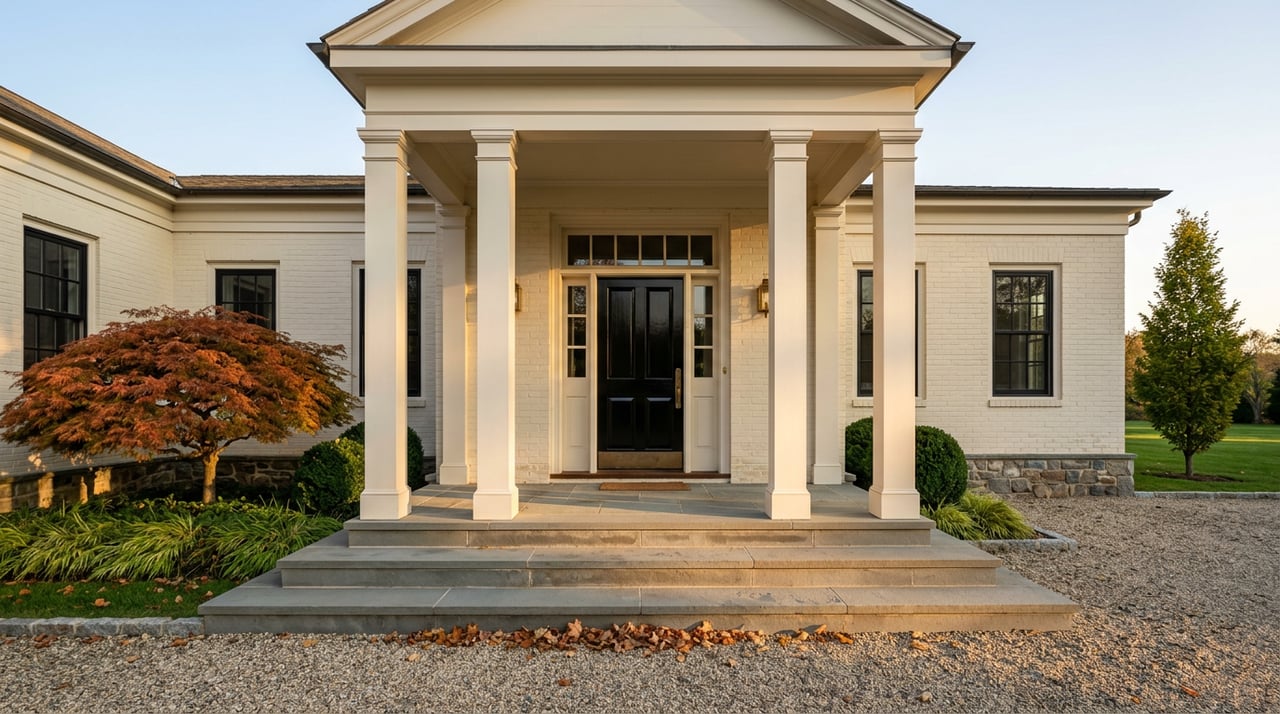
Lewisburg's Median Home Price Is Real. It Just Isn't Describing Your Street.
September 24, 2026
September 24, 2026
A buyer looking at Lewisburg from outside the market usually starts with one number: the median. Somewhere in the high $300s to low $400s, depending on which site they pulled it from. They do the math, land on a comfortable middle-of-the-pack budget, and assume that number describes the kind of house $400,000 buys here.
It doesn't. Not because the number is wrong, but because it's describing something closer to a coastline than a neighborhood. Lewisburg's active housing stock this year has run from roughly $125,000 to just under $2.5 million, a span wide enough that the midpoint tells you almost nothing about what sits on either side of it. And the two most commonly cited figures for that midpoint don't even agree with each other.
One live-inventory snapshot, taken as of May 2026, counted 34 houses for sale in Lewisburg, priced between $124,999 and $2,499,900, with a median list price of $379,900 and an average sale price of $406,836. Homes were spending a median of 48 days on the market before going under contract.
A separate countywide tracking service, pulling from a broader catchment across Union County, named Lewisburg the priciest city in the county with a median listing price of $404,700, inside a countywide value range of $59,255 to $2,499,900.
Same town, same general season, two medians roughly $25,000 apart. That gap isn't a data error. It's what happens when a market has very few transactions spread across a very wide price ladder. With only a few dozen active listings covering a 20-times spread between the cheapest and priciest home, which specific properties happen to be listed on the day someone pulls the data will move the midpoint by tens of thousands of dollars. Add or remove three or four homes from either end of that range and the median shifts again.
That's the first thing worth sitting with before you anchor a budget or a listing price to a single figure. In a market this size, the median isn't a stable description of "typical." It's a snapshot of whoever happened to be on the market that week.
The more useful question isn't "what's the median," it's "where does the top of that range actually live." Because it isn't scattered evenly across town. It clusters in a small number of identifiable places, and each one has its own reason for sitting where it does on the price ladder.
New construction facing the golf course. Some of the highest list prices this year belong to newer homes built on multi-acre lots directly across from Bucknell Golf Course, the kind of setting with mature trees, a pond, and a barn rather than a fenced-in suburban yard. These are priced closer to the top of the range not because "Lewisburg" commands a premium everywhere, but because new construction on acreage with a golf course view is a different product than a resale colonial three blocks from downtown.
Wyndham Hills. This is the neighborhood name that keeps surfacing in the upper-middle to upper end of the market: homes running 4,500 to 4,800-plus square feet, several with in-ground pools, pool houses, and picnic pavilions built for entertaining. A buyer comparing a Wyndham Hills listing against the countywide median is comparing square footage and amenities that the median was never built to capture.
River-bluff properties off Skyline Drive. At the far end of the spectrum sits a smaller category of homes set high above the Susquehanna, reached by private lanes, where the selling point is the view through a wall of windows rather than proximity to Market Street. These listings aren't competing with anything downtown. They're competing with two or three other river-view properties, if that many exist on the market at the same time.
Meanwhile, the low end of the range is anchored by something entirely different: older in-town housing stock, some of it built well over a century ago, sized and priced for buyers who want walkability and character over acreage and square footage. A downtown property from the 1850s and a new build across from the golf course can both carry the "Lewisburg" label and share almost nothing else.
If your budget lands near that median figure, whichever version of it you're using, the practical question isn't whether you're "at the median." It's which pocket of the market your price point actually reaches. A buyer at $400,000 isn't competing against golf-course new construction or Skyline Drive river views. They're most likely looking at resale homes in established, walkable neighborhoods, competing against other buyers targeting that same tier, with the 48-day median time on market as a rough guide to how quickly well-priced homes in that range are moving.
The mistake is treating the median as a ceiling or a floor for the whole town. It's neither. It's the middle of a list that includes both ends, and the ends don't behave like the middle.
The same logic runs in reverse for sellers with a higher-end property. If your home sits in Wyndham Hills, on acreage near the golf course, or on a river bluff, the town-wide statistics aren't your real comparison set. Your actual competition is the small handful of homes in that same pocket that happen to be listed at the same time you are. Pricing strategy, staging decisions, and even the pace you should expect toward an offer all need to be built around that narrower comparison, not the countywide average.
This is where local, transaction-level familiarity with those specific pockets matters more than any aggregate statistic. Teresa Keeley has represented both sides of that gap in this market, buyers finding their footing in the $300s and sellers moving properties at the top of the range, work that RealTrends Verified credited with $15.41 million in 2024 volume and the top ranking in Lewisburg by both transaction sides and dollar volume. That kind of track record comes from knowing which few homes actually compete with yours, not from reading the same median everyone else is reading.
If the median keeps shifting, how should I judge whether a listing is priced fairly? Compare it against recently sold homes in its specific pocket, similar lot size, similar age of construction, similar amenities, rather than against a townwide number. A golf-course new build and a downtown Federal-style home were never priced off the same curve.
Does the $2.499 million ceiling mean Lewisburg has an active luxury market, or is that one outlier listing? Both figures I found, the live-inventory snapshot and the countywide tracking data, capped out at the same number this year, which suggests it reflects a real top tier rather than a single anomaly. But a luxury ceiling that appears once or twice a season is still a thin market. Pricing and timing decisions at that level should be built around the two or three true comparables that exist, not a broader average.
Should I ignore the median altogether? No. It's still useful as a rough gauge of where the overall market sits. The mistake is trusting it to describe your specific street, lot, or price tier without checking what's actually clustered there.
If you're trying to figure out which pocket of Lewisburg your budget or your listing actually belongs in, that's a conversation worth having before you make an offer or set a price. Teresa Keeley has spent more than twenty years watching how these micro-markets move independently of the headline number, and can walk you through what your specific street is really competing against. Schedule a consultation to start that conversation.
Teresa delivers a refined and highly personalized approach to Pennsylvania real estate. Her commitment to exceptional service and meaningful relationships creates a seamless experience from start to finish. Discover the difference trusted representation can make.
23 North Derr Dr Ste 28 Lewisburg, PA 17837